The British Flag Explained: Why the Union Jack Is Asymmetric (2026)
You’ve looked at the Union Jack a thousand times, but you probably haven’t really looked at it. Something about it feels slightly off, even if you couldn’t say why. The lines don’t mirror each other. The balance is strange. And that’s not an accident.
The British flag is deliberately asymmetric, built from layered history, politics, and compromise. Once you know what you’re seeing, you can’t unsee it. Here’s how the Union Jack came together—and why it looks the way it does.
But the Union Jack is not just a design.
It is an asymmetric political document, frozen in cloth, that can be flown upside down as a signal of distress, misread as an insult, or used as a quiet statement of identity. And once you notice how it works, you’ll never see it the same way again.

What the British Flag Really Is
The British flag, officially called the Union Flag and commonly known as the Union Jack, is the national flag of the United Kingdom.
Many people still believe there’s a rule: “Union Jack at sea, Union Flag on land.”
There isn’t.
That myth was formally put to rest in 1908, when Parliament confirmed that Union Jack is an acceptable name in all contexts. Land. Sea. Ceremony. Everyday use.
Two names. One flag. Zero legal contradiction.
The Design That Refuses to Be Symmetrical
At first glance, the Union Jack looks balanced.
It isn’t.
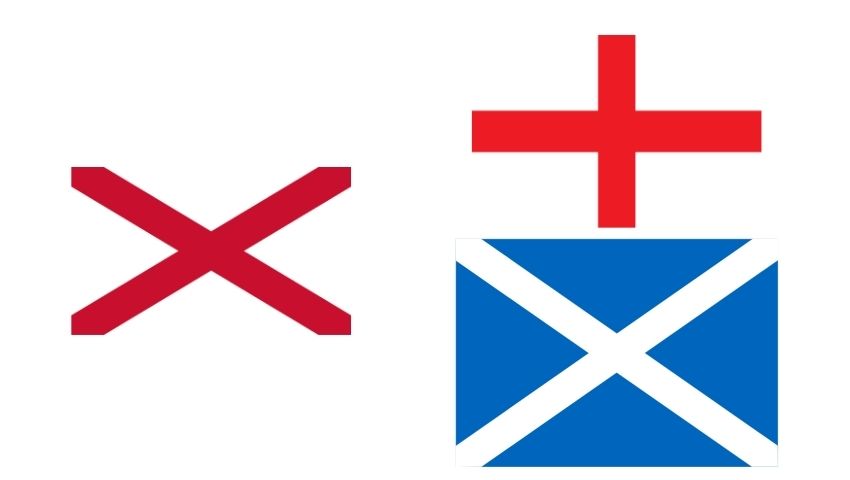
The flag deliberately layers three heraldic crosses, each representing a constituent part of the United Kingdom:
- England: The red Cross of St George on white
- Scotland: The white diagonal Cross of St Andrew on blue
- Ireland (Northern Ireland): The red diagonal Cross of St Patrick on white
Here’s the part most people miss:
The diagonal crosses are offset on purpose. This was done to show respect for the older Scottish saltire, which sits visually “above” the Irish saltire in one direction.
This means the Union Jack has a correct orientation.
Hang it the wrong way, and you are not just making a design error. You are changing its meaning.
A Flag Born From Political Compromise
The story of the British flag begins in 1603, when James VI of Scotland also became James I of England. Two crowns. One monarch. Separate kingdoms.
That personal union created a problem: how do you visually represent shared sovereignty without erasing identity?
In 1606, the first Union Flag was created, combining England’s and Scotland’s crosses. It was initially used at sea, where questions of allegiance mattered most.
The design became official on land after the Acts of Union in 1707, which formed the Kingdom of Great Britain.
The flag you recognise today arrived on 1 January 1801, when Ireland formally joined the union. The red saltire of St Patrick was added, creating the modern Union Flag.
Nothing about this design is accidental. Every layer marks a moment where unity had to be negotiated, not assumed.
Note: Flags featuring a lion over crossed swords are often confused with the Union Flag. These are British Army non-ceremonial flags, adopted in 1938, and are not the national flag.
What the Union Jack Symbolises in 2026
In 2026, the Union Jack still symbolises one core idea: administrative and political union.
It visually binds the patron saints of three nations:
- St George – England
- St Andrew – Scotland
- St Patrick – Ireland
Wales is not separately represented because, when the first Union Flag was created, Wales was already legally part of the Kingdom of England.
Does the British Flag Have Legal Status?
Here’s another surprise.
There is no Flag Act in the United Kingdom.
The Union Jack is the national flag by custom and long-established practice, not by a single founding law.
In England, Scotland, and Wales, there are no civil penalties for flying the flag incorrectly on private property.
Northern Ireland is different.
There, the Flags Regulations (Northern Ireland) legally control when and where the Union Flag must be flown on government buildings, and on which designated days. These rules remain in force in 2026.
There is also no single, legally mandated way to fold the Union Flag. The Royal Navy and ceremonial units follow traditional folding methods, but these are conventions, not laws.
Flying the Union Jack Upside Down
Because the flag is asymmetric, it can be flown upside down.
Today, doing so is usually seen as disrespectful or incorrect.
Historically, however, it served a clear purpose: a maritime distress signal.
If you want to check orientation, look at the upper corner nearest the flagpole. The broader white diagonal stripe must sit above the red diagonal.
Union Jack vs British Flag: Is There a Difference?
No.
They are the same flag. Different names. Same cloth.
What matters isn’t the label. It’s what the flag represents: a union built through negotiation, compromise, and history rather than symmetry or simplicity.
Once you see that, the Union Jack stops being decoration.
It becomes a story — and one that’s still being read.